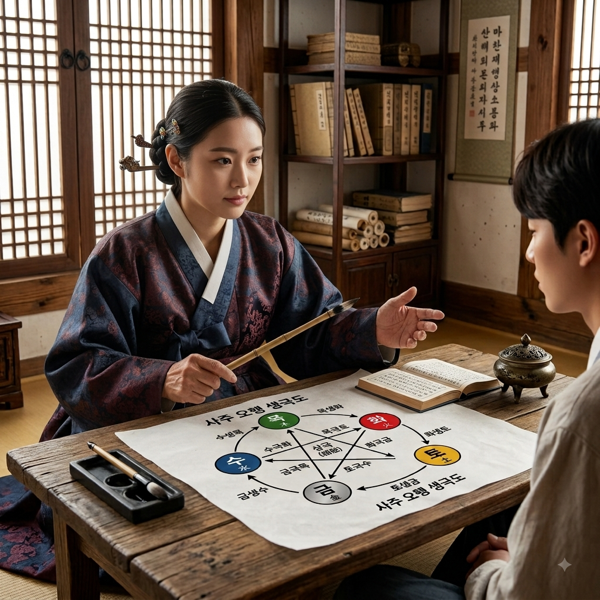
You know your zodiac sign. You've read your horoscope. But have you ever wondered why two Leos can have completely different personalities, or why your "compatible" sign pairing didn't work out? Western astrology groups 8 billion people into 12 categories. Saju (사주, saju) doesn't.

The core difference in 10 seconds
Western astrology asks: What month were you born?
Saju asks: What year, month, day, AND hour were you born?
That's the difference between one data point and four. Western astrology gives you a sun sign. Saju gives you eight characters across four pillars — a chart so specific that two people born on the same day but different hours will have different readings.
How Western astrology works
Western astrology is built on the ecliptic — the sun's apparent path across the sky. Your "sign" is determined by which constellation the sun was in when you were born:
- 12 signs based on birth month (Aries through Pisces)
- Sun sign is the primary identifier
- Full natal charts add Moon sign, Rising sign, and planetary positions
- Interpretation is based on mythology, archetypes, and planetary aspects
It's elegant and culturally dominant — almost everyone in the West knows their sign. But your sun sign only uses your birth month. That's 1/12th of the population sharing the same reading.
How Saju works
Saju (사주, saju, literally "four pillars") is built on the sexagenary cycle (육십갑자, yuksip gapja) — a 60-year repeating system of Heavenly Stems and Earthly Branches rooted in the Five Elements:
- 4 pillars based on birth year, month, day, and hour
- 8 characters (팔자, palja) — each pillar has a Heavenly Stem + Earthly Branch
- Five Elements (오행, ohaeng) — Wood, Fire, Earth, Metal, Water — instead of planetary bodies
- Day Master (일간, ilgan) — YOUR core element, determined by the day you were born (not the month)
The key: your Day Master changes every day, not every month. There are 60 possible Day Masters vs. 12 zodiac signs. And when you factor in all four pillars, the number of unique charts is in the hundreds of thousands.
Side-by-side comparison
| Western Astrology | Saju (사주) | |
|---|---|---|
| Based on | Sun's position (ecliptic) | Sexagenary cycle (60 stems & branches) |
| Core identity | Sun sign (birth month) | Day Master (birth day) |
| Precision | 12 types | 60 Day Masters × 4 pillars |
| Birth time | Optional (for Rising sign) | Essential (determines Hour Pillar) |
| Elements | 4 (Fire, Earth, Air, Water) | 5 (Wood, Fire, Earth, Metal, Water) |
| Animals | 12 zodiac signs (monthly) | 12 zodiac animals (yearly) |
| Daily readings | Based on sun sign transits | Based on daily stem-branch vs. your chart |
| Compatibility | Sign pairings (e.g., Leo + Sagittarius) | Element interaction between two full charts |
| Origin | Ancient Greece / Babylon | Ancient China / Korea |
| Cultural base | Western world | Korea (사주), China (팔자, palja / BaZi), Japan (사주추명, sajuchumyeong) |
What Saju catches that astrology misses
1. Two Scorpios walk into a room...
In Western astrology, everyone born October 23 – November 21 is a Scorpio. That's roughly 630 million people sharing the same sun sign traits.
In Saju, two people born on November 1st and November 15th have completely different Day Masters — different core elements, different strengths, different life patterns. They might both be "Scorpios" but their saju charts could be as different as fire and water — literally.
2. The hour matters — a lot
Western astrology uses birth time mainly for the Rising sign (Ascendant). Many people don't know their birth time, and most horoscopes ignore it entirely.
In Saju, your birth hour determines your entire Hour Pillar — 2 of your 8 characters. A person born at 3 AM vs. 3 PM on the same day has a fundamentally different chart. The Hour Pillar represents your inner self, your late-life direction, and your relationship with your children.
3. Elements interact, not just describe
Western astrology's four elements (Fire, Earth, Air, Water) are mostly descriptive labels — "Fire signs are passionate." They don't interact mechanically.
Saju's Five Elements have a dynamic system:
- Generating cycle (상생, sangsaeng): Wood feeds Fire → Fire makes Earth → Earth bears Metal → Metal holds Water → Water grows Wood
- Controlling cycle (상극, sanggkeuk): Wood parts Earth → Earth blocks Water → Water quenches Fire → Fire melts Metal → Metal cuts Wood
Your chart isn't just "you have a lot of Fire." It's "your Fire is generating too much Earth, which is blocking your Water, which means your emotional depth is suppressed by your need for stability." That level of nuance doesn't exist in sun-sign astrology.
4. Compatibility is calculated, not assumed
Western astrology compatibility is mostly based on sign pairings — "Aries and Libra are opposites that attract." It's a broad generalization based on one data point per person.
Saju compatibility (궁합, gunghap) compares all eight characters of both people — how their Day Masters relate, whether their elements fill each other's gaps, and where their stems and branches clash. Two "compatible" zodiac signs might have terrible saju chemistry, and vice versa.
Where Western astrology has the edge
Let's be fair — Western astrology does some things Saju doesn't:
- Planetary transits: Western astrology tracks ongoing planetary movements (Saturn return, Mercury retrograde) that create a dynamic, evolving narrative. Saju has luck cycles (대운, daeun) but they're less culturally embedded.
- Accessibility: Everyone knows their zodiac sign. Saju requires knowing your birth date, time, and running a calculation. The barrier to entry is higher.
- Cultural ubiquity: "What's your sign?" is a universal icebreaker. "What's your Day Master?" isn't — yet.
- Visual richness: Natal charts with planetary wheels are visually striking. Saju charts are grids of characters — powerful but less immediately appealing.
So which one should you use?
Both. They're not competing systems — they're different lenses on the same question: who am I?
Think of your zodiac sign as your headline. Think of your Saju chart as the full article. Your sun sign gives you a quick label. Your four pillars give you the nuance behind it.
If you only know your zodiac sign, you're reading the title of a book. Saju lets you read the chapters.

FAQ
Is Saju more accurate than Western astrology?+
Saju uses four data points (year, month, day, hour) vs. Western astrology's primary one (birth month). More data generally means more precision. Whether that translates to "accuracy" depends on what you're looking for — quick personality labels or detailed life mapping.
Can I use both Saju and Western astrology?+
Yes — many people do. Your zodiac sign and your Day Master can coexist. They often describe different facets of your personality that complement each other.
Is Saju the same as Chinese BaZi?+
They share the same foundation (Four Pillars, Five Elements, sexagenary cycle). Saju (사주) is the Korean interpretation, BaZi (팔자, palja) is the Chinese version. The calculations are the same; the cultural context and interpretation traditions differ.
Why don't more people know about Saju?+
Western astrology had centuries of cultural export through European colonialism and American pop culture. Saju stayed regional — deeply embedded in Korean culture but not globally marketed. That's changing as K-culture goes global.
Do I need to know my birth time for Saju?+
It makes your chart more complete (adding the Hour Pillar), but you can still get a meaningful three-pillar reading without it. Your Day Master — your core identity — only requires your birth date.
This guide is for reflection and entertainment, not professional advice.